2026
A roadmap for conducting more inclusive research on brain resilience in ageing and dementia
Authors:
Rajah, M. N., Dixon, R. A., Einstein, G., Stern, Y., & Brain Resilience and Diversity in Aging and Dementia Collaboratory
Journal:
Nature Reviews
Abstract:
The variability in cognitive and brain ageing trajectories may be influenced by inter-individual and community-level differences in resilience that result from differential exposures to social and structural determinants of health and be affected by an individual’s sex and gender. However, no clear guidance exists on how to best integrate these diversity-related factors (that is, sex, gender and social and structural determinants of health) into clinical and cognitive neuroscience research on resilience in ageing and dementia. The international Brain Resilience and Diversity in Aging and Dementia (BReDAD) Collaboratory was established in 2024 with the goals of synthesizing knowledge, identifying knowledge gaps and developing recommendations for conducting more inclusive research on resilience in this area. On the basis of a focused review of the literature, and discussions held and recommendations made by the Collaboratory, in this Roadmap article, we present a way forward for integrating diversity in future resilience research. This proposal comprises: (i) developing trust and meaningful long-term relationships with communities historically excluded from research; (ii) diversifying who is engaged in all aspects of the research process; (iii) adopting a life-course perspective; (iv) improving and expanding research designs and measurement tools; and (v) using sensitive computational analytics and mixed methods for testing complex, intersectional models. We conclude by recommending a transdisciplinary approach in resilience research to better reflect the complexities inherent in studying diversity and developing precision medicine outcomes.
Plain Language Summary:
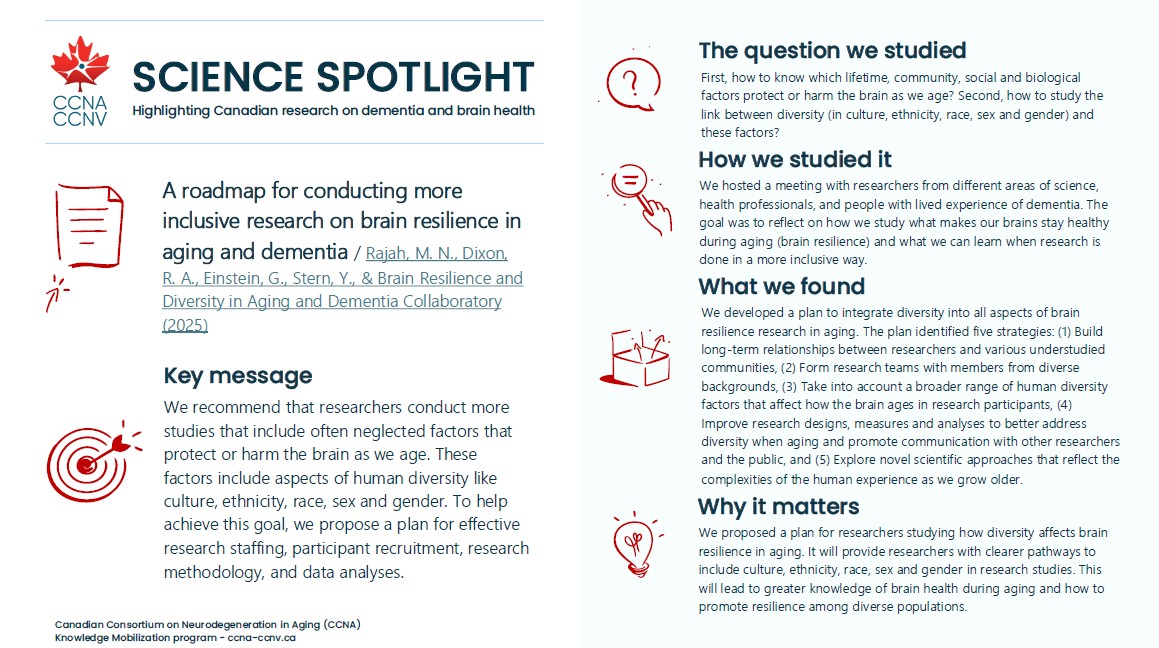
The question we studied: First, how to know which lifetime, community, social and biological factors protect or harm the brain as we age? Second, how to study the link between human diversity (in culture, ethnicity, race, sex and gender) and these factors that protect or harm the brain as we get older?
How we studied it: We hosted a 2-day meeting with researchers from different areas of science, health professionals, and people with lived experience of dementia. The goal was to think together about how we study what makes our brains stay healthy during aging (brain resilience), and what we can learn when this research is done in a more inclusive way.
What we found: We developed a plan for integrating diversity into all aspects of brain resilience research in human aging. The plan identified five essential parts: (1) researchers building long-term relationships with various understudied communities, (2) research teams with members from diverse backgrounds, (3) taking into account a broader range of factors that affect the life course of aging research participants, (4) improving research designs, measures and analyses to more effectively address diversity and aging resilience issues and to promote enhanced communication with other researchers and the public, and (5) exploring novel scientific approaches that reflect complexities of human experience and change.
Why it matters: The plan in the paper can be used as a guide by researchers studying how diversity affects brain resilience in aging. This guide will provide researchers with clearer knowledge about how including culture, ethnicity, race, sex and gender in our research studies can lead to enhanced knowledge of brain resilience during aging and how to promote resilience among diverse populations.
Share

Receive the
latest news
Stay updated with the latest research developments from CCNA-CCNV. Our news section provides insights into cutting-edge studies, advancements in dementia care, and key findings in brain health research.