2025

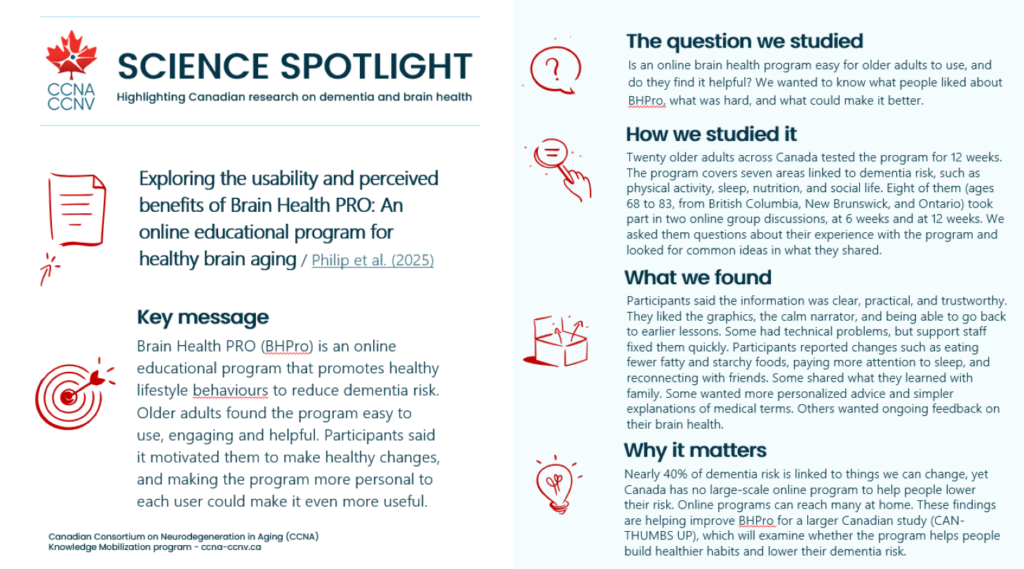
Exploring the usability and perceived benefits of Brain Health PRO: An online educational program for healthy brain aging

Authors:

Philip, G., Fiocco, A. J., Belleville, S., Chertkow, H., Feldman, H. H., Montero-Odasso, M., Nygaard, H. B., Savundranayagam, M. Y., & Canadian Consortium on Neurodegeneration in Aging (CCNA), CAN-THUMBS UP Study Group

Journal:

Digital Health

Abstract

Background: Brain Health PRO (BHPro) is a 45-week online educational program designed to promote healthy lifestyle behaviors and reduce dementia risk. Available in both English and French, it provides information and guidance on seven modifiable dementia risk factors: physical activity, cognitive engagement, nutrition, sleep, social and psychological health, vascular health, and vision and hearing. Upon completing a short intake questionnaire, users receive a personalized risk profile to guide their priorities and goals, with ongoing feedback throughout the program.

Objective: This study aimed to explore the usability and perceived benefits of BHPro over a 12-week period.

Methods: Eight community-dwelling older adults across Canada (ages 68-83; four male, four female) pilot-tested the program. Virtual focus groups were conducted at two time points: after 6 weeks and after 12 weeks of participation. Transcripts were analyzed using thematic analysis, organizing codes into sub-themes and themes.

Results: Three main themes emerged: (1) Content-participants appreciated the likability, accessibility, and informativeness of the program; (2) Mechanics-comfort with technology, the usefulness of program features, and enjoyment of narration and graphics; (3) Engagement and Learning-participants reported increased motivation, new knowledge, behavioral changes, and desire for continuous feedback.

Conclusion: Participants shared positive experiences with the online content and interface, benefitting on new knowledge gained while highlighting behavioral changes. The need for greater personalization in future iterations was emphasized. The BHPro pilot was well received by older adults, who found the platform usable, engaging, and beneficial. Findings offer insights into using online platforms to support brain health.

Plain Language Summary

Background: Brain Health PRO (BHPro) is an online educational program that promotes healthy lifestyle behaviours to reduce dementia risk. Program content includes an overview of risk factors for dementia, and lifestyle behaviours that support brain health. The order of the content for each user is based on their risk profile. For example, if a user does not do any physical exercise, this content of the program will be presented to this user first.

Objective: To explore the usability, likability, and perceived benefit of the BHPro over a 12-week period.

Methods: Two focus groups were conducted with 10 older adult participants after 6 and 12 weeks of engaging with the program.

Results: Participants shared feedback on three themes: 1) Content, including how much they liked it, how accessible the content was and how informative it was; 2) Mechanics (technical issues), including technology comfort and importance of tech support, the purpose of program features, enjoyment of narration and graphics; and 3) Engagement and Learning, including new knowledge, behavioural changes, perceived benefits and need for continuous feedback. Overall, participants reported positive experiences with the online program content and interface. Participants benefited from new knowledge gained and highlighted changes in behaviour. The participants thought that an important next step in program development would be to personalize more of the technical features of program.

Conclusion: The BHPro pilot was well received by older adults, who found the platform usable, engaging, and beneficial. These findings offer insights on using online platforms to support brain health.

Share

CCNA - CCNV white logo

Receive the
latest news

Stay updated with the latest research developments from CCNA-CCNV. Our news section provides insights into cutting-edge studies, advancements in dementia care, and key findings in brain health research.

Illustration of elderly people on a park bench