2026
Temporally consistent survival prediction for non-uniform longitudinal data
Auteurs:
Fah, H., Greiner, R., & Dixon, R. A.
Revue:
Journal of biomedical informatics
Abstract
Objective: Traditional survival prediction models use a patient’s covariates at a single time point to estimate the time until a specific event occurs, such as death or hospital readmission. However, in many longitudinal datasets, patient covariates are recorded at multiple time points, typically with varying intervals. Our objective is to learn a survival prediction model by training on longitudinal datasets with non-uniform time intervals between covariate measurements, both within and across patient trajectories.
Methods: We propose a new algorithm, Temporally Consistent Multi-Task Logistic Regression (TC-MTLR), which incorporates concepts from distributional reinforcement learning to model survival outcomes. Unlike existing dynamic survival prediction algorithms, TC-MTLR is designed to leverage the non-uniformity of longitudinal measurements. We evaluate this method against two standard and two dynamic survival prediction algorithms across three short and three long longitudinal datasets, including two related to healthcare.
Results: On short datasets, TC-MTLR achieves top performance in Concordance Index (C-Index) and Uncensored Mean Average Error (MAE-Uncensored) while displaying mixed results according to Integrated Brier Score (IBS) and Pseudo-Observable MAE (MAE-PO). However, on long datasets, TC-MTLR achieves similar C-Index performance as the other survival predictions methods while outperforming them according to MAE-PO and achieving top performance according to MAE-Uncensored and IBS.
Conclusion: TC-MTLR effectively utilizes the non-uniform temporal structure of longitudinal datasets, offering a competitive and often superior alternative to existing survival prediction models.
Plain Language Summary
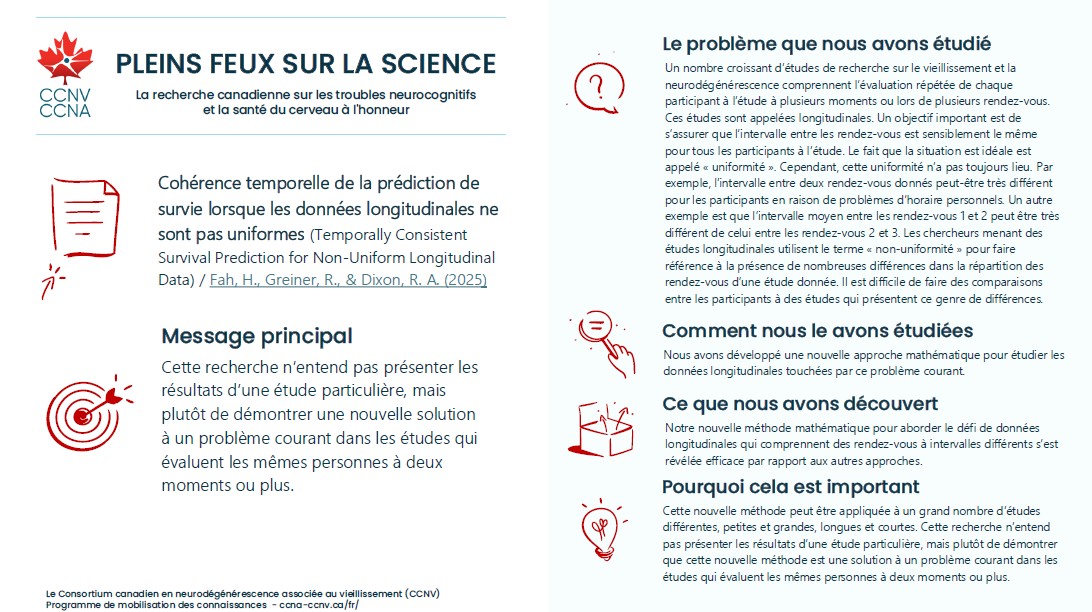
The question we studied: This is a « methodological » study designed to address a major challenge for researchers investigating specific research questions with datasets that include multiple health indicators of many participants who have been followed and re-assessed across two or more time points. A common challenge is that there is non-uniformity in the interval between successive time points of assessments.
How we studied it: An increasing number of research studies on aging and dementia are conducted with longitudinal designs. Such designs involve the repeated assessments of each person in the study over multiple time points. Some of the studies will have uniform numbers of assessments spaced by very similar intervals. Other studies, such as CCNA and some based on individualized clinical follow-ups, have non-uniform intervals between assessments. The non-uniform nature of some longitudinal studies presents challenges to our efforts to precisely analyze the available time-structured information for important patterns and associations. This article presents a new computational approach to integrating longitudinal data with non-uniform intervals between assessments.
What we found: We developed a new “algorithm” for addressing the computational complications of non-uniformity in longitudinal data. This article is methodological and thus tests various computational alternatives. Our new algorithm showed effective performance across multiple comparisons with other approaches.
Why it matters: The results are encouraging in that the new algorithm can be applied to many different longitudinal studies, both small and large, both shorter and longer. This study is not intended to present results of a specific investigation but rather to demonstrate the viability and generalizability of this new algorithmic approach to a common problem in longitudinal studies of aging and dementia.
Partager

Recevez les
dernières nouvelles
Suivez les derniers développements de la recherche au sein du CCNA-CCNV. Notre section «Nouvelles» fournit des informations sur les études, les avancées et les principaux résultats de la recherche en matière de santé cérébrale.